Why Does the Structural System Choice Matter More for Metal Building Projects Today?
EasyFrame Metal Buildings use cold-formed steel components that eliminate welding, reduce lead times, and simplify installation compared to traditional red-iron pre-engineered metal buildings. For many projects, those differences directly impact schedule, labor, and overall cost.
For years, the structural system was often treated as a standard decision. Today, it carries more weight.
Longer lead times for red-iron pre-engineered metal buildings (PEMBs), tighter construction schedules, and rising labor and equipment costs have made structural choices more visible at every stage of a project. What happens before materials arrive on site now directly affects how efficiently a building goes up.
That shift has led more contractors and building owners to evaluate alternatives.
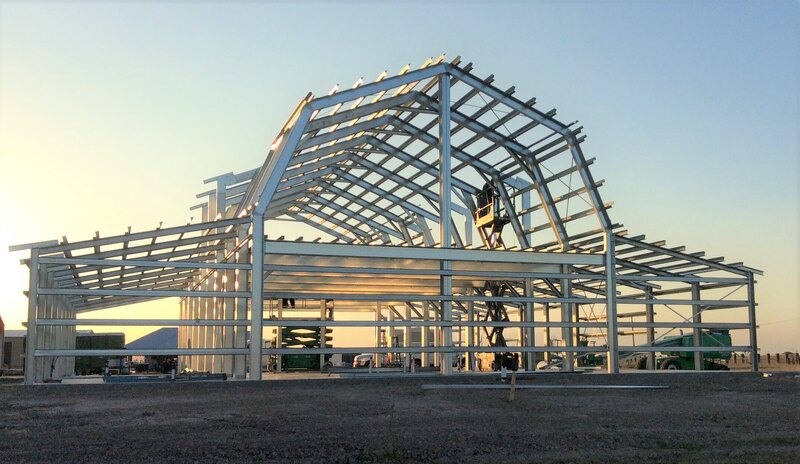
EasyFrame buildings represent one of those alternatives. Built on a cold-formed steel approach, they change how structural components are manufactured, delivered, and assembled. Instead of relying on welded, made-to-order frames, EasyFrame systems use factory roll-formed members that arrive ready to assemble, removing several of the constraints that can slow projects down.
What Makes EasyFrame Cold-Formed Steel Buildings Different from Traditional PEMBs?
EasyFrame buildings use factory roll-formed, cold-formed steel components that require no welding or field fabrication. Traditional PEMBs rely on hot-rolled red iron frames that are welded and fabricated to order, which can extend project timelines.
The difference starts with how the structure is made.
EasyFrame components are produced from steel coils that are shaped at ambient temperatures through a continuous roll-forming process. This method forms precise substructural members such as Cee sections, channels, and eave struts without the need for heat or welding. Because the process is controlled and repeatable, components are manufactured with consistent tolerances and arrive ready for assembly.
Traditional PEMBs follow a different path. Primary frames are cut, welded, and fabricated as part of a custom-engineered package. That process introduces sequencing and dependency on fabrication capacity before materials ever reach the jobsite.
There are also practical differences in how the systems are framed.
EasyFrame buildings typically use more frequent framing lines, often 10 to 20 feet apart, compared to the wider 25 to 30-foot bay spacing common in PEMB systems. While that means more structural members, those members are lighter and easier to handle.
Instead of setting large welded frames with a crane, crews assemble the structure using smaller components. That changes how the building is staged, how crews are deployed, and how the project progresses in the field.
How Do EasyFrame Buildings Help Reduce Project Lead Times Compared to Red-Iron PEMBs?
EasyFrame buildings are manufactured from roll-formed components that can be produced and delivered in weeks, rather than the months often associated with red-iron PEMBs.
Lead time is often one of the most immediate differences contractors notice.
With traditional PEMBs, production is tied to fabrication schedules. When demand increases, those systems move into a queue. In the years following 2020, it was not uncommon for red-iron building lead times to extend well beyond several months due to fabrication backlogs and supply chain constraints.
EasyFrame buildings are produced differently. Because components are continuously roll-formed from coil stock, production is not dependent on a welding sequence or a fabrication slot. This allows materials to move through manufacturing more quickly and predictably.
For contractors, that translates into earlier project starts, more reliable delivery timelines, and a reduced risk of schedule disruptions caused by material delays.
There is also a field advantage. EasyFrame components arrive ready to assemble, reducing the need for on-site modification. That consistency helps crews maintain momentum and reduces time spent adjusting structural elements during installation.
Learn more about EasyFrame Metal Buildings in this contractor interview with Jason Sellers.
Why Can EasyFrame Buildings Be More Efficient to Install Than Traditional Steel Buildings?
EasyFrame buildings use lighter, distributed structural components that reduce the need for heavy equipment and can simplify foundation requirements.
Installation efficiency often comes down to how the structure carries the load and how it is handled on-site.
EasyFrame buildings distribute loads across multiple framing members rather than concentrating them at a few primary frames. This can reduce the demand on individual columns and, depending on the project, simplify foundation design. Contractors often report reduced concrete requirements compared to traditional red-iron systems, though results vary by application.
Another factor that can influence both cost and project coordination is engineering.
With EasyFrame buildings, stamped, engineered drawings and foundation plans are typically included in the building package. In many traditional construction scenarios, those items are developed separately through an engineer of record, which adds additional scope to the project.
Depending on the size and complexity of the building, including these engineered documents up front can result in cost savings of approximately $1,500 to $5,000. It can also help streamline the early phases of construction by reducing the need for additional coordination between project stakeholders.
The difference is also clear in equipment needs.
PEMB erection typically requires cranes to lift and place large welded frames. That introduces equipment costs, scheduling coordination, and potential delays due to weather or site constraints.
With EasyFrame, components are smaller and lighter. Many can be handled by two-person crews or installed using man lifts rather than cranes. That allows skilled labor to stay focused on installation rather than equipment coordination or material handling.
Over the course of a project, those efficiencies can compound. Fewer equipment days, simpler logistics, and more effective use of labor all contribute to a smoother installation process.
Are EasyFrame Cold-Formed Steel Buildings Structurally Capable for Commercial Construction?
EasyFrame buildings are engineered to meet required wind, snow, and seismic loads for their intended applications, including wind speeds exceeding 115 MPH.
Cold-formed steel systems have been used for decades in regions with demanding wind requirements, and their performance is based on engineered design rather than member size alone.
EasyFrame buildings are designed to meet applicable building codes for a range of applications and environments. Their structural approach allows them to perform in areas where wind exposure is a key consideration.
As all-steel systems, EasyFrame buildings are also typically classified as noncombustible under standard construction classifications. That distinction can be relevant when evaluating fire resistance and may influence insurance considerations when compared to wood-framed structures.
EasyFrame systems also support a range of configurations, including single-story and multi-level designs. Models such as the Georgian and Vintage demonstrate how cold-formed steel can be applied to residential-style or mixed-use structures, not just utility buildings.
Where Do EasyFrame Buildings Have Structural Limitations?
EasyFrame buildings are generally best suited for spans up to approximately 60 feet. Projects requiring larger clear spans, wide column-free spaces, or specialized structural demands are often better suited for traditional PEMBs.
This is an important distinction.
EasyFrame is not intended to replace PEMBs in every scenario. Buildings that require long, uninterrupted interior spans, such as certain industrial facilities, manufacturing buildings with overhead cranes, or structures with very high eave heights, often rely on red-iron framing.
There are also cases where a structural engineer has specified a PEMB system based on project requirements. In those situations, the structural approach is driven by design criteria rather than preference.
Being clear about these limitations helps ensure the right system is matched to the right project.
What Types of Projects Are the Best Fit for EasyFrame Metal Buildings?
EasyFrame buildings are well-suited for agricultural structures, hobby shops, garages, barndominiums, recreational facilities, and light commercial buildings where span requirements fall within typical limits.
In practice, EasyFrame performs best in projects where efficiency, speed, and straightforward construction are priorities.
Agricultural buildings and hobby shops are a natural fit, with models like the Farmstead supporting equipment storage, workshops, and general-purpose use.
Garage and residential-style applications are another strong category. The Parker model is designed for garage use, while the Georgian and McCormick models support barndominium and shouse-style living spaces. For projects that require additional vertical space, the Vintage model offers a two-story configuration.
Recreational and specialty-use buildings also align well with the system. Designs such as the Pickler and Lollygagger models demonstrate how EasyFrame can support sports and activity-based facilities where speed of construction and cost control are priorities.
Even smaller-scale applications, such as storage buildings, follow the same pattern. The system's consistency and ease of assembly make it well-suited for projects where predictability matters as much as performance.
Additional information on available models and configurations can be found on the EasyFrame Models page.
Choosing Between EasyFrame Buildings and Traditional Pre-Engineered Metal Buildings
EasyFrame buildings and traditional pre-engineered metal buildings are not competing solutions in every situation. Each serves a purpose depending on the structural and operational needs of the project.
Where EasyFrame stands out is in projects that benefit from shorter lead times, simplified installation, and reduced reliance on heavy equipment. Those differences can influence both schedule and cost as a project moves forward.
If you are evaluating options for an upcoming project, reviewing available EasyFrame models and discussing project-specific requirements can help determine whether this approach aligns with your building needs.


.jpg?width=767&name=How%20to%20install%20a%20metal%20roof%20that%20lasts%20in%20coastal%20environments%20(2).jpg)
.png?width=440&height=293&name=How%20to%20Install%20Metal%20Roofing%20Over%20Existing%20Metal%20Roofs%20(1).png)
Comments on this article:
Scroll down to the bottom to submit a comment and join the conversation. Need help or have a question? Please contact us. Looking for a distributor or contractor? Please click here to get started.