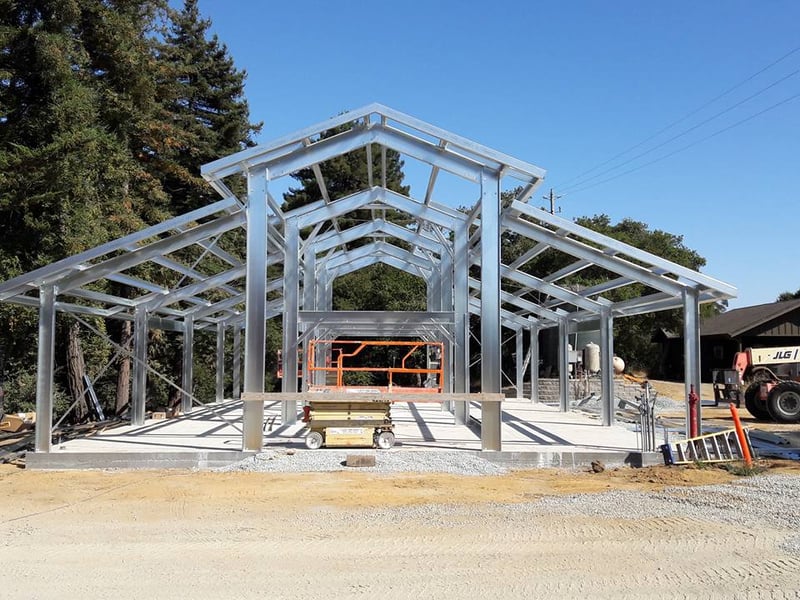
EasyFrame is McElroy Metal's cold-formed steel building system, engineered for fast quoting, rapid delivery, and bolt-together field assembly without welding or field cutting. Quotes can be produced in about 10 minutes, full buildings engineered in five days or less, and a building delivered to site in three to four weeks. Cold-formed steel takes one to three man-hours to process per ton, compared with 13 to 16 hours for traditional red iron construction. To get a working perspective on how these buildings perform on real jobs and why contractors are adopting them, we sat down with Jason Sellers, a sales professional with nearly seven years of experience in cold-formed buildings who works with McElroy Metal's EasyFrame division. Jason shares insights on the benefits, construction process, and unique aspects of EasyFrame metal buildings.
How did Jason Sellers get involved with cold-formed steel buildings?
Jason entered the cold-formed steel building industry about seven years ago after a background in general sales, and he joined McElroy Metal in the late spring of this year.
"I started working in cold-formed buildings about seven years ago. Coming from a sales background, I didn't know much about them. However, I quickly appreciated their uniqueness and the opportunity to build customer relationships. It felt like I had found my true calling when I first encountered cold-formed buildings."
Jason decided to make the switch to McElroy for two main reasons: the company's established reputation, with over 60 years in the business, and its strong commitment to customers, employees, and community. He was also drawn by the company's potential for growth in the cold-formed segment.
What is EasyFrame construction, and where does the design come from?
EasyFrame is McElroy Metal's trade name for its cold-formed steel building system, and its defining advantage is speed across every stage from quote to erected structure.
"EasyFrame comes from the cold-formed side of things. One significant advantage is speed. We can produce a quote in 10 minutes, engineer full buildings in five days or less, and have a building on the ground in three to four weeks."
What does cold-formed steel mean, and how is it different from traditional buildings?
Cold-formed steel is shaped at room temperature by rolling and bending operations rather than being hot-dipped or hot-rolled. The resulting components bolt together in the field with no welding or cutting required, which is why some contractors compare the system to a large erector set.
"Cold-formed means it comes from a cold-formed roll of steel. It's not hot-dipped. The steel goes into a machine that bends it according to our software specifications. This process allows for rapid production and assembly. The buildings bolt together without drilling or cutting required in the field. Some people compare it to a giant erector set."
What are the major benefits of an EasyFrame metal building?
The biggest benefits of EasyFrame are labor speed, aesthetic appeal from clean galvanized steel without exposed welds, and built-in cost advantages from included engineered drawings and shorter project timelines.
.jpg?width=800&height=600&name=Mechanical%20Equipment%20(6).jpg)
"Speed is a significant advantage. With traditional red iron construction, you're looking at 13 to 16 man-hours to process one ton of steel. With cold-formed steel, it's just one to three hours. The aesthetic appeal is another benefit. The buildings are galvanized steel, without welds that might look unsightly. They have a clean, precise appearance."
There are also direct cost advantages. Stamped engineer and foundation drawings are included with every project, saving builders upwards of $1,500. The shorter timeline for production and erection compounds the savings on labor and financing.
What are the contractor advantages and disadvantages compared to traditional construction?
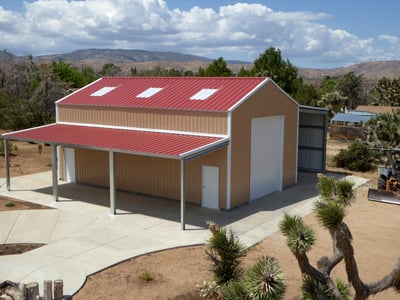
For contractors, EasyFrame eliminates heavy I-beam handling, welding, and preset J-bolt anchoring, while shorter delivery and assembly timelines free up crews to take on more annual projects. The trade-off is mostly preference for crews accustomed to traditional methods.
"Advantages include not handling heavy I-beams, no welding required, and the ability to anchor directly to the foundation without worrying about preset J-bolts. The quick delivery and assembly time mean contractors can potentially complete more projects."
"Disadvantages can be a matter of personal preference. Some contractors who have worked with traditional methods for decades might prefer to stick with what they know."
Why choose a McElroy EasyFrame building over a competitor's?
"McElroy is a well-recognized, respected name with over 60 years in the business. We have 14 manufacturing plants across the country, so we can serve customers efficiently regardless of their location. We also have 29 service centers, 44 metal marts, and an extensive distributor network. This means customers will likely be served by someone in their local area who understands their needs."
How difficult is it for contractors to learn EasyFrame construction?
Most contractors can learn the EasyFrame system after one or two projects, supported by a complete set of engineered drawings, a detailed construction packet, and a parts list with stamped IDs that tie directly to the drawings.
"Most contractors can pick it up fairly easily. We provide a full set of engineer drawings, a detailed construction packet, and a parts list with stamped IDs that tie directly to the construction packet. I always encourage contractors to try two projects - most of the time, they're eager to continue after that."
What are the most challenging aspects of building an EasyFrame structure?
The biggest challenge is finding contractors who understand the system, since EasyFrame differs from traditional construction methods in meaningful ways, even though the assembly itself is approachable.
"The main challenge is often finding the right contractor who understands these buildings. While they're not overly complex, they differ from traditional construction methods. I've seen very large, nice buildings put together by husband-and-wife teams or friends working on weekends."
What does a unique EasyFrame project look like in practice?
EasyFrame buildings can be engineered for unusual applications, including a salt mining operation in which the structure was mounted on a rail system to allow it to be moved to access the underlying salt pumps.
"One interesting project was a building on a rail system for a salt mining operation supplying McDonald's. The building could be moved on rails to allow access to the salt pumps while providing weather protection. It was a unique application of our technology."
How do EasyFrame buildings handle extreme conditions, insulation, and moisture control?
Insulation is critical for any steel building because uninsulated structures will sweat in any climate. EasyFrame's roof and sidewall systems are designed to accommodate a wide range of insulation values, including high R-value assemblies up to R-45.
"Insulation is crucial for all steel buildings, regardless of location. Without proper insulation, the building will sweat. We're seeing increasing demands for high R-value insulation, up to R-45 in some cases. Our roof and sidewall systems are designed to accommodate various insulation options."
What tools and equipment do contractors need for EasyFrame construction?
EasyFrame construction is primarily a bolting and screwing system, so most contractors already own the tools they need.
"Not really. Most contractors can work with equipment they already have, like scissor lifts. They'll need basic tools like clamps, a concrete drill, a laser level, spud wrenches, cordless drills and impact drivers, aviation snips, and possibly a side grinder. It's primarily a bolting and screwing system."
What can impact the timeline of an EasyFrame project?
 "The most common issues arise from not taking the time to properly understand the plans, construction packet, and parts list. Proper organization of materials on-site is crucial. We've had cases where important components were accidentally used as walkways in muddy conditions, leading to delays."
How do EasyFrame buildings integrate with windows, doors, and HVAC systems?
EasyFrame buildings integrate with windows, doors, HVAC systems, solar panels, and other equipment the same way traditional buildings do, provided the specifications are known during the engineering phase.
"It's similar to traditional buildings. As long as we know the specifications upfront, we can accommodate these elements in the design. This includes considerations for HVAC systems, solar panels, or equipment like vehicle lifts. Our engineering process takes all these factors into account."
Can EasyFrame buildings be modified or repaired after construction?
Modifications and additions are possible after the building is complete, but the ease with which they can be made depends on whether the original design anticipated them. Additions are much easier when planned from the start.
"Modifications are possible, but they can be challenging depending on the nature of the change. For example, adding mezzanines or lean-to structures depends on the original building design and available connection points. It's always easier if these elements are planned for in the initial design."
How does EasyFrame technology continue to evolve?
EasyFrame technology evolves through ongoing software development with engineering partner ACT and through close attention to market demand, most recently, increased interest in barndominium-style buildings and more complex designs like wraparound porches.
"Our software constantly evolves, and we work closely with our software partner, ACT. We also pay close attention to market trends. For instance, we're seeing increased demand for barndominium-style buildings and for more complex designs, such as wraparound porches. There are some limitations due to the cold-formed steel process, but we're always looking for ways to expand our capabilities."
How can contractors and builders become EasyFrame partners with McElroy Metal?
Contractors and builders can become EasyFrame partners by visiting McElroyMetal.com and using the Find a Contractor/Distributor section, or by reaching out directly through EasyFrame@McElroyMetal.com or the corporate office.
"They can visit our website at McElroyMetal.com and navigate to the 'Find a Contractor/Distributor' section. Alternatively, they can email us at EasyFrame@McElroyMetal.com or call our corporate office."
How does McElroy minimize waste and improve job-site efficiency?
McElroy minimizes waste through accurate parts counts and proper packaging, and improves project efficiency by coordinating with its supplier network on long-lead items like doors, windows, and HVAC components that often cause budget overruns.
"We put a lot of effort into ensuring accurate parts counts and proper packaging. This helps minimize waste on the job site. As for efficiency, we've found that taking a team approach and leveraging our supplier network can help avoid delays in components and budget overruns."


.png?width=767&name=How%20to%20Install%20Metal%20Roofing%20Over%20Existing%20Metal%20Roofs%20(1).png)
.jpg?width=767&name=How%20to%20install%20a%20metal%20roof%20that%20lasts%20in%20coastal%20environments%20(2).jpg)
.png?width=440&height=293&name=How%20to%20Install%20Metal%20Roofing%20Over%20Existing%20Metal%20Roofs%20(1).png)
Comments on this article:
Scroll down to the bottom to submit a comment and join the conversation. Need help or have a question? Please contact us. Looking for a distributor or contractor? Please click here to get started.