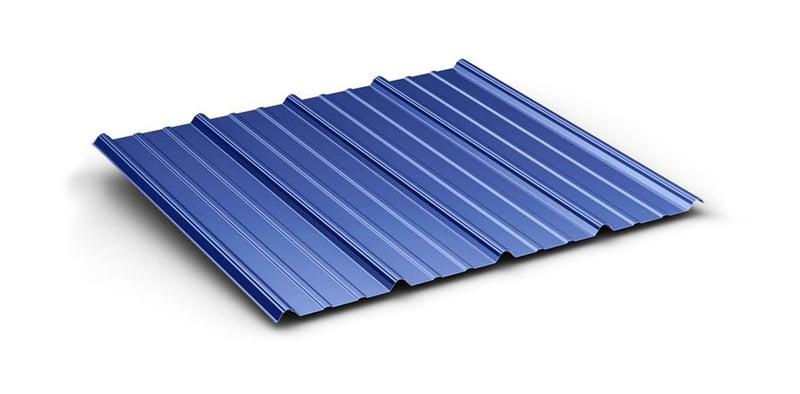
If you are putting siding on a pole barn, exposed fastener metal wall panels are almost always the answer. They cost less than concealed-fastener systems, go up fast, and protect post-frame walls for decades. Two profiles handle the bulk of pole barn jobs: McElroy Metal's Max-Rib and Mesa. This guide explains why exposed fastener panels dominate pole barn siding, how Max-Rib and Mesa differ, and how to match a panel and finish to the way you want your building to look and perform.
What Is the Best Siding for a Pole Barn?
Exposed fastener metal wall panels are the most popular siding for pole barns. They are the most economical metal panel type, they install quickly, and they hold up for decades on post-frame walls. For most projects, McElroy Metal's Max-Rib and Mesa are the two profiles that get specified.
Pole barns are an engineered wood-frame building system that meets UBC and IBC standards. Instead of closely spaced wood studs, steel framing, or concrete masonry, they use large solid-sawn posts or laminated columns to carry the structural load. Those posts transfer the load to the ground or to a concrete pier or masonry foundation. The result is a building that is typically less expensive and faster to erect than other construction methods, with wide open interior spans and no need for interior load-bearing walls.
That framing system shapes the siding decision. Wall panels on a pole barn fasten to horizontal girts spanning between posts, so a panel that screws directly into the framing is a natural fit. Exposed fastener metal panels do exactly that, which is why they have become the default choice for pole barn walls.
McElroy stocks its most popular pole barn profiles in the gauges and finishes post-frame builders ask for, including Kynar 500® PVDF in both 26 GA and 29 GA, which many competitors do not offer in post-frame thicknesses.
Why Are Exposed Fastener Panels the Top Pole Barn Siding Choice?
Exposed fastener panels are the most economical metal panel type, and they install faster than concealed-fastener systems because the panels overlap and fasten straight through the face into the framing. Lower material cost plus quicker labor is why they are the standard for pole barn siding.
 With exposed fastener systems, screws pierce the metal panel and anchor into the substructure below. Concealed-fastener panels hide their fasteners under clips or behind slotted flanges, which adds material and installation time. For a utility building, a shop, or an agricultural structure where the wall does not need to disappear visually, the exposed fastener approach delivers the performance without the added cost. Most exposed fastener panels cover 36 inches per sheet and are produced in 24 to 29 gauge, so the panel can be matched to the wind and snow loads the wall will see.
Longevity is the other half of the value story. The Galvalume® substrate under the paint resists corrosion well enough that a 2014 Metal Construction Association and Zinc Aluminum Coaters Association study projected a minimum 60-year service life for Galvalume standing seam roof systems. On the finish side, a 2015 National Coil Coating Association study of PVDF (Kynar 500®) coated panels in South Florida exposure testing projected a minimum 40-year service life for the coating. Those numbers reflect roof testing, but the same substrate and coating science protects metal wall panels, which is part of why pole barn siding lasts so much longer than the wood or vinyl it often replaces.
Both Max-Rib and Mesa are built on that Galvalume foundation, giving pole barn owners the economy of exposed fastener installation without giving up the durability metal is known for.
What's the Difference Between Max-Rib and Mesa Panels?
Max-Rib and Mesa are both low-profile exposed fastener panels with a 3/4-inch major rib spaced 9 inches on center, so they perform similarly. The difference is appearance and product range: Mesa uses a nearly invisible lap for a cleaner, monolithic look, while Max-Rib comes in several performance tiers so you can match the panel to your budget and longevity goals.
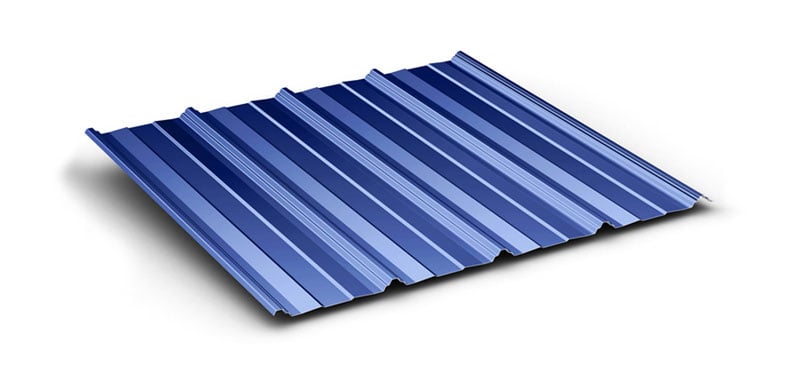 The Mesa panel is a proprietary McElroy profile, patent and copyright protected, with a lap detail that minimizes the visual line where panels overlap. That nearly invisible lap creates a continuous, monolithic appearance across walls and roof, which appeals to owners who want their pole barn or barndominium to read as a finished home rather than a utility shed. Mesa pairs that look with a Kynar 500® (PVDF) coating system for the longest-lasting color retention available.
The Max-Rib family is the workhorse. It is offered in five options: Max-Rib Ultra, Max-Rib II, Max-Rib 100, Max-Rib 185, and Max-Rib Commodity, so you can dial in performance, longevity, and price. Max-Rib Ultra carries the premium Kynar 500® PVDF finish and is the tier most often chosen when appearance and color life matter, while the lighter tiers serve commodity agricultural work where first cost drives the decision.
Both panels share the same 3/4-inch rib height and 9-inch on-center major rib spacing, so they install with familiar detailing. Choosing between them usually comes down to whether you want Mesa's cleaner seam line or Max-Rib's range of cost-to-performance tiers.
What About Soffit, Trim, and Color Matching?
Finish the underside of your overhangs with Matrix soffit panels, available in 12-inch and 16-inch widths. Matrix comes in colors that match McElroy wall panels in both Silicone Modified Polyester (SMP) and Kynar 500® PVDF, so the soffit, walls, and trim read as one coordinated building.
The soffit choice is also where the SMP-versus-PVDF decision shows up again. SMP is the value coating and performs well in many applications, while Kynar 500® PVDF holds its color and gloss longer, especially under strong sun. Matching the soffit coating to the wall panel keeps color aging consistent across the building so one surface does not fade ahead of another. For more detail, McElroy compares the two systems in its Kynar 500 vs. SMP guide.
Because McElroy produces wall panels, soffit, and trim under one roof, the color formulations are engineered to coordinate, which removes the guesswork of trying to match parts from different suppliers.
How Do You Choose the Right Pole Barn Siding for Your Project?
Choose your pole barn siding by weighing three things: how you want the building to look, how long you want the finish to hold its color, and your budget. A Kynar 500® PVDF finish costs more upfront but keeps its color far longer than SMP, Mesa gives the cleanest seam appearance, and the Max-Rib tiers let you match cost to the performance you actually need.
Gauge matters too. Heavier 24 GA panels span farther between girts and carry more load, while 29 GA is common on lighter agricultural walls. Your builder or McElroy can match the gauge to the girt spacing and the wind and snow loads in your area, so the wall is engineered rather than guessed. For a workshop or barndominium you plan to live in, leaning toward Mesa or Max-Rib Ultra with a Kynar 500® finish protects both the look and the long-term value. For straightforward storage or equipment buildings, a lighter Max-Rib tier often makes more sense.
McElroy Metal is employee-owned, so the people answering your questions and producing your panels have a direct stake in getting the specification right the first time. That ownership shows up as accountability when you need help choosing a profile, gauge, or finish for your project.
Learn More About Post Frame Buildings
Explore McElroy's post frame building resources or browse post frame project photos to see how different panel profiles, finishes, and colors look on completed projects.


.jpg?width=767&name=Can%20You%20Paint%20a%20Metal%20Roof_%20(4).jpg)
.png?width=440&height=293&name=R%20Panel%20vs%20Ag%20Panel%20(1).png)
Comments on this article:
Scroll down to the bottom to submit a comment and join the conversation. Need help or have a question? Please contact us. Looking for a distributor or contractor? Please click here to get started.