Choosing a metal roof is the easy part. Most homeowners who reach that decision have already worked through the performance case and are confident in the investment. Then the color selector opens, and suddenly there are dozens of options with no obvious criteria for narrowing them down.
The right metal roof color does more than look good from the street. It works with your home's architecture, responds to your local climate, and maintains its appearance over decades of use. This guide walks through the decisions that matter: paint system, architectural fit, climate, and design direction, so you can make a choice you will still be satisfied with years from now.
Does metal roof color affect more than your home's appearance?
Color on a metal roof affects energy performance, long-term appearance, and how cohesively the exterior reads as a whole. It is not a purely aesthetic decision.
Unlike shingles, metal panels arrive from the factory pre-coated with a high-performance paint system. That coating is the outermost layer protecting the substrate over time. The color you choose influences how much solar energy the roof reflects, which can affect cooling demand in warmer climates, and how noticeable any future color change may be.
Lighter colors reflect more sunlight, while darker colors absorb more heat. This property, measured as solar reflectance, is what drives cool roof performance. The U.S. Department of Energy has documented that reflective roofing materials can help reduce cooling energy use, particularly in hotter climates. The actual impact varies based on insulation, building design, and location.
Color also plays a central role in how the home’s exterior is perceived. Because the roof covers a large portion of the visible structure, it tends to anchor the overall palette. Siding, trim, and accent colors are typically read in relation to the roof, not independently.
McElroy Metal offers a Visualizer tool that allows homeowners to test color selections on sample projects or upload a photo of their own home to preview options before making a final decision.
What paint system is on a metal roof, and why does it matter?
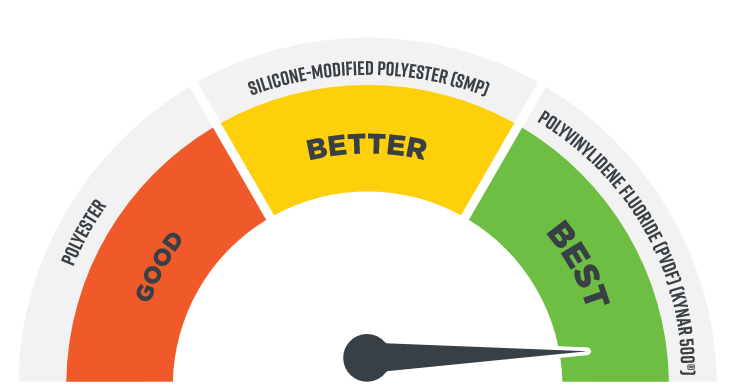
Metal roof panels are coated with industrial paint systems, not standard house paint, and the differences between those systems determine how long the color will look the way it does from day one. The three main coating types are PVDF (Kynar 500®), Silicone-Modified Polyester (SMP), and Polyester.
The most useful way to think about them is a good-better-best framework. Polyester is the baseline. It performs adequately in the short term but shows the most chalk and fade over time, and should not be specified for residential applications where longevity matters. SMP is an improvement; it uses a higher-quality resin system than straight polyester, but it remains subject to noticeable fade and chalking, sometimes within just a few years on darker colors. Kynar 500® (PVDF) is the top tier.
PVDF coatings have been the standard for architectural metal roofing since the 1960s. The resin chemistry resists ultraviolet degradation in a way that SMP simply cannot match. McElroy Metal's residential eBook documents a real-world case study that makes the difference impossible to ignore: identical shades of green were installed side by side on a Louisiana home, one panel set using Kynar 500®, the other using SMP. Eight years later, the SMP panels showed clear chalk and color shift. The Kynar 500® panels showed neither.
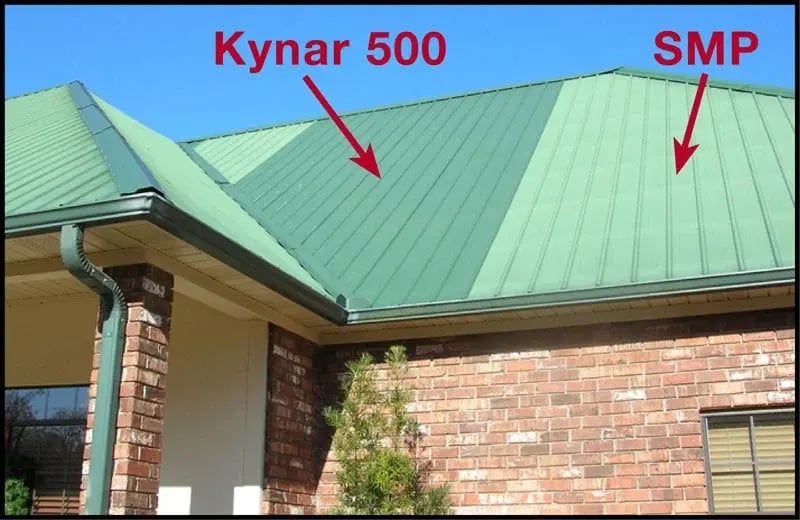
That story matters because color fade is cumulative. What looks like a minor shift in year three becomes a more pronounced difference by year ten. A roof that no longer matches the trim it was originally paired with is a problem that cannot be solved without a full recoating, an expense that undermines the entire economics of choosing metal in the first place.
McElroy Metal stocks Kynar 500® as a standard offering across its architectural, commercial, and post-frame product lines. Not every manufacturer does. When evaluating panel options, it is worth asking specifically which coating system comes standard and whether Kynar 500® is available.
The Metal Construction Association offers certification for painted metal roofing products that meet specific performance standards. The MCA Certified Premium Painted label indicates Kynar 500® (PVDF) coating. Seeing that label on bundle packaging is a reliable indicator that the coating meets its long-term performance claims.
 How does architecture guide the right metal roof color?
Your home's architectural style can be a reliable starting point for narrowing color options. Each major residential style has an established palette, one that has worked across thousands of installations, and starting there can significantly reduce the risk of a choice you might later want to redo.
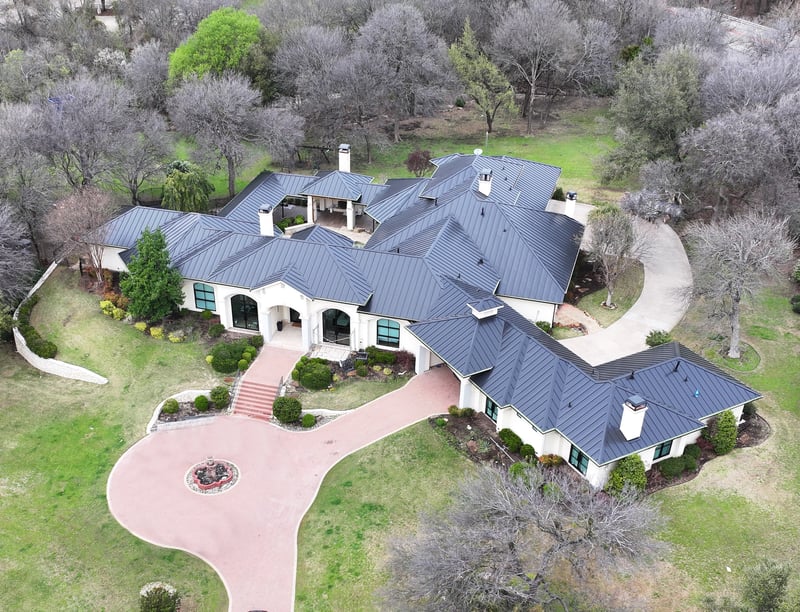
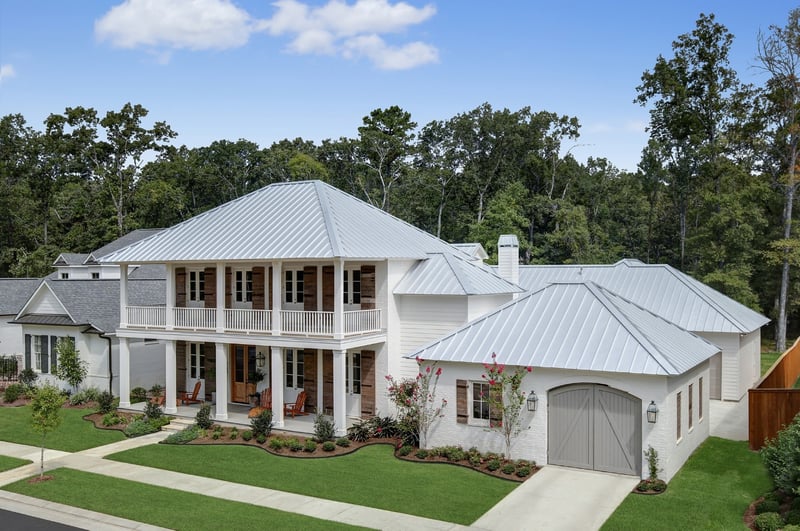
Classic colonial and traditional homes, with their symmetrical facades and formal proportions, have long paired well with darker roof colors. Deep charcoal, matte black, and dark gray all read as sharp and deliberate against white or off-white exteriors. The contrast is intentional; it reinforces the clean lines those styles are built around.
Farmhouse and rural styles take a different approach. The enduring combination of a dark roof with a light exterior works here, too, but earth tones open up as a second strong option. Forest green, deep red, and warm brown roof colors all integrate well with wood, stone, and brick; materials that appear frequently in rural construction. These combinations tend to be especially successful in mountainous, lakeside, or heavily wooded settings where the building needs to relate to the landscape rather than stand apart from it.
Mediterranean and Southwest-influenced homes point toward terracotta, clay, warm beige, and tan. In climates with constant intense sun, those warmer tones also offer a practical advantage: they reduce surface glare without requiring a very light color. Coastal homes lean toward lighter, softer palettes. Light stone, almond, and soft gray roof colors paired with white, pale blue, or sage green siding are a well-established pattern in coastal communities across the country.
Modern and contemporary homes offer the most flexibility. Minimalist exteriors with clean lines tend to carry dark and high-contrast choices well: charcoal, graphite, and metallic finishes all complement the deliberate simplicity of that aesthetic. Brick and natural stone exteriors benefit from neutral tones that play off the warm undertones already present in the material. Browns and grays tend to work; anything that clashes with the masonry's natural color will be obvious for as long as the roof is on the building.
Color also affects perceived height. A lighter roof color makes a home read as taller and can add visual lift to a shallow-pitch structure. A darker color lowers the visual profile, which can make a high-pitched roof feel more grounded. That is a minor consideration for most homeowners, but it is worth knowing for applications where the roofline is a prominent feature.
Panel geometry is part of the color decision. The Medallion-Lok, one of McElroy's most popular residential standing seam panels, is available in 12", 16", and 18" widths with flat, striated, and ribbed pan options. A narrower striated pan in charcoal reads differently on a traditional colonial than a wider flat pan in the same color; the profile carries as much visual weight as the shade. McElroy Metal's photo gallery, organized by building type and filterable to residential single-family projects, shows how those combinations read on actual structures rather than renderings.
How does climate change which color you should choose?
In hot climates, lighter roof colors with higher solar reflectance reduce the amount of heat transferred into the building below. In cooler or mixed climates, darker tones make practical sense aesthetically and do not carry the same energy penalty.
Solar reflectance is the percentage of solar energy that a roofing surface reflects rather than absorbs. It is measured alongside thermal emittance to produce a Solar Reflectance Index (SRI) value. Colors with higher SRI values keep the roof surface cooler, which reduces the heat that migrates into the attic or living space below. White and light colors carry the highest SRI values; dark colors carry the lowest.
In hot southern and southwestern climates, that difference is meaningful. The U.S. Department of Energy has documented that cool metal roofing can reduce cooling energy use, with the specific savings depending on climate zone, building design, and existing insulation. Areas where air conditioning runs for six or more months a year see the greatest returns from choosing a light or medium-value roof color.
In the Pacific Northwest, the upper Midwest, or New England, the calculus is different. Cooling loads are lower, and darker roof colors — navy, dark green, deep bronze, dark brown — fit naturally within those regional aesthetic traditions. As Sherwin-Williams®' Brynn Wildenauer noted in McElroy Metal's color trends interview, the Northeast features blues, greens, and bronzes that reflect both the climate and the architectural heritage of the region. Choosing a color that fits the regional vernacular almost always results in a roof that reads as intentional rather than arbitrary.
Will my metal roof color fade over time?
Whether a metal roof fades depends largely on the paint system. A Kynar 500® (PVDF) coated panel in a dark color will hold its appearance far longer than an SMP-coated panel in the same shade.
Fade occurs when ultraviolet exposure attacks the pigment in the paint system. Chalk occurs when UV degradation breaks down the resin, leaving a whitish residue on the surface. Both are visible, and both accumulate over time. The degree to which they occur is a function of the coating's resin chemistry, not the underlying color.
SMP coatings use a resin system that is more susceptible to UV breakdown than PVDF. On lighter colors, the fade is less visible, which is why SMP can sometimes be considered adequate for light-colored panels. On darker colors, navy, forest green, dark bronze, charcoal, and black, fade on SMP coatings becomes increasingly obvious as the years pass. What starts as a subtle shift by year five is a clear mismatch by year twelve.
Kynar 500® resins resist that degradation at a fundamentally different level. The resin chemistry developed in the 1960s has been refined over decades, but remains based on polyvinylidene fluoride, which simply does not break down under UV exposure the way polyester-based systems do.
One frequently misunderstood aspect of paint warranties is that warranty terms do not guarantee what you can actually see on the roof. ASTM procedures require cleaning the panel surface before measurements are taken to assess warranty compliance. What looks to a homeowner like an obvious fade may not technically exceed the warranty threshold once the chalk is removed. Reading the warranty carefully before selecting a contractor, and making sure Kynar 500® is specified in writing, is the best protection.

What metal roof color trends matter for homeowners?
Metal roof color trends tend to evolve gradually, but the broader design direction is shifting in a noticeable way. Sherwin-Williams®’ 2026 forecast points toward a return to warm, grounded, and nature-inspired color palettes, an approach centered on long-term livability rather than short-term trend cycles.
That shift is showing up in several practical ways. Warmer neutrals are replacing the cool grays and stark whites that have dominated exterior design in recent years. Instead of high-contrast combinations, homeowners are moving toward more cohesive, tone-on-tone palettes that feel more integrated with the home and surrounding landscape.
Natural influence is a consistent thread. Colors drawn from earth and environment—khaki, clay, warm browns, and muted greens—are becoming more common because they age well visually and feel appropriate across a wide range of architectural styles.
There is also less emphasis on bold or high-contrast combinations. Design direction is favoring depth and subtle variation over brightness. Metallic finishes are shifting toward more subdued, satin-like appearances rather than high-sparkle finishes.
Sherwin-Williams® positions this direction as a move toward colors that are functional, adaptable, and built to last. That aligns with the long lifecycle of a metal roof, where color decisions should remain appropriate for years, not just current design preferences.
Regional preferences remain consistent. Warmer tones dominate in sun-intensive regions, while deeper blues, greens, and bronzes continue to appear in northern markets. These patterns tend to remain stable and provide a reliable reference point.
Because roofing is a long-term investment, color trends should be viewed as guidance rather than direction. Selecting a color that fits the home, the environment, and the intended lifespan of the roof is typically a more reliable approach than following short-term design cycles.
Does metal roof color affect your home's resale value?
A well-chosen roof color can strengthen curb appeal and contribute positively to buyer perception. A color that clashes with the home's architecture or appears faded and dated works against resale. That said, the quality and condition of the roofing system itself matter more than the specific shade.
Neutral colors and regionally appropriate palettes tend to perform better at resale than highly personal choices. Charcoal, dark bronze, warm brown, and aged copper tones are broadly appealing across buyer demographics and tend not to polarize the way bold colors can. Lighter palettes work well in coastal and warm-climate markets, where they carry both aesthetic and energy logic.
The more meaningful variable at resale is whether the roof shows its age. A metal roof with Kynar 500® coatings that still looks sharp at twenty years is a clear positive for buyers; it signals a long remaining service life and no near-term replacement cost. A roof that has faded or chalked raises questions about the quality of the original installation, regardless of how good the color choice was at the time.
A metal roof is a long-term decision, and the color is part of that commitment.



.png?width=440&height=293&name=R%20Panel%20vs%20Ag%20Panel%20(1).png)
Comments on this article:
Scroll down to the bottom to submit a comment and join the conversation. Need help or have a question? Please contact us. Looking for a distributor or contractor? Please click here to get started.