Garages, workshops, and hobby shops are some of the hardest-working buildings on a property. They protect vehicles, tools, equipment, and projects that often represent a serious investment, and they're used year-round in every kind of weather.
Because these spaces are built for function, owners need roofing and building systems that prioritize durability, low maintenance, and long-term value. Metal roofing and, in many cases, metal cold-formed building systems, continue to be a smart fit for garages, workshops, and hobby shops of all sizes.
This guide explains why metal performs so well for these building types, what to consider when selecting a system, and how structure, panel choice, and intended use influence performance.
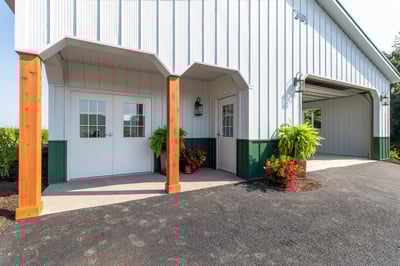 Why Metal Roofing Works for Garages and Workshops
Garages and workshops are typically designed around utility, with roofs that must withstand daily use, temperature swings, vibration, and exposure without requiring constant attention.
Metal roofing aligns well with these needs by offering long service life compared to traditional asphalt shingles, strong resistance to wind, rain, and impact, minimal maintenance over time, compatibility with open interiors and exposed framing, and proven performance for detached and accessory buildings.
For owners looking to build once and avoid frequent repairs or replacement, metal roofing provides a dependable, long-term solution.
Durability for Everyday Use
Commercial structures that house businesses often see more physical stress than many other building types. Doors open and close constantly. Vehicles and equipment move in and out. Interior conditions can fluctuate dramatically depending on use.
Metal roofing systems are engineered to remain secure and intact under these conditions. When properly selected and installed, panels maintain attachment and performance without cracking, loosening, or deteriorating the way traditional materials often do.
Building Size and Roof Design Matter
Roof geometry plays a significant role in system selection.
Simple gable or single-slope designs often allow for a wide range of metal panel options. Buildings with hips, valleys, or multiple roof planes typically benefit from vertical seam systems that are easier to keep watertight at transitions and penetrations.
Building size also impacts panel selection. Longer roof runs may require systems designed to accommodate thermal movement without stressing fasteners or seams. Understanding these design factors early helps ensure the roof performs as intended over the life of the building.
Exposed-Fastener vs. Standing Seam Systems
Both exposed-fastener and standing seam metal roofing systems can be appropriate for garages and workshops, depending on priorities.
Exposed-fastener systems are commonly chosen for budget-focused projects, straightforward roof designs, and utility-driven buildings.
Standing seam systems are often selected when long-term watertight performance is a priority, a cleaner, more finished appearance is desired, and long-term curb appeal is important, especially when using high-performance paint systems like Kynar 500 coatings, which are designed to retain color and finish over time.
The right choice depends on how the building will be used, the desired lifespan, and the owner's performance expectations.
Panel Selection: Matching the Right Metal Panel to the Job
Garages and workshops are typically more utility-driven, with simpler roof geometries, open interiors, and different budget and use requirements than residential homes or large commercial facilities. Selecting the right panel profile helps balance performance, appearance, and cost, especially for functional buildings where longevity matters more than aesthetics alone.
Trapezoidal and Ribbed Panels for Utility-Focused Buildings
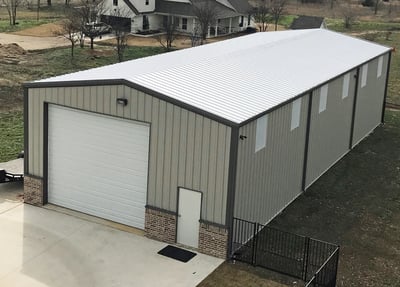
For many garages and workshops, ribbed metal panels are a practical choice. These profiles are commonly used on straight gable or single-slope buildings and offer an efficient balance of durability and installed cost.
They perform well on detached garages, agricultural workshops, equipment storage buildings, and light commercial shop spaces.
Their profile geometry provides consistent strength and rigidity, making them a reliable option for open interiors and straightforward roof designs commonly used in garages and workshops.
 Standing Seam Panels for Long-Term Performance
Standing seam metal roofing systems are often selected when long-term watertight performance and reduced maintenance are priorities. These systems use continuous vertical seams and concealed attachment methods, which helps limit exposure to weather over time.
Standing seam panels are a strong fit for conditioned garages or workshops, hobby shops with finished interiors, buildings expected to be upgraded or repurposed, and owners prioritizing long service life.
On buildings with more complex roof geometries, penetrations, or transitions, overall performance is driven largely by detailing and flashing design rather than the panel profile alone.
Appearance vs. Function
While appearance may not be the primary concern for every garage or workshop, many owners still want a finished look that complements nearby structures. Metal panels are available in a range of profiles, colors, and finishes, allowing garages, workshops, and hobby shops to complement nearby homes or other structures without sacrificing performance.
The key is selecting a panel system that aligns with how the building will actually be used, not just how it looks on day one.
Residential vs. Light Commercial Garages: Key Differences to Consider
Garages and workshops often blur the line between residential and commercial use, but there are important differences that influence building and roofing decisions.
Residential Garages and Hobby Shops
Residential garages are typically smaller in scale and may be attached or detached from a home. These spaces are often used for vehicle storage, personal projects, or recreational hobbies.
Key considerations include budget sensitivity, visual compatibility with the home, moderate interior use, and simpler roof designs.
Metal roofing works well in these applications by offering durability without requiring frequent upkeep, especially for detached garages exposed to the elements.
Light Commercial and Professional Workshops
Light commercial garages and workshops tend to see heavier daily use. These buildings may house professional equipment, vehicles, or tools that are essential to ongoing operations.
Additional considerations often include larger building footprints, higher interior clearance, more frequent door cycles, greater exposure to vibration and movement, and longer expected service life.
In these environments, metal roofing systems are often selected for their ability to withstand ongoing use while minimizing maintenance interruptions.
Planning for Growth
One common factor across both residential and light commercial garages is future expansion. What starts as a basic garage can quickly evolve into a workshop, storage space, or small business operation.
Metal roofing and building systems provide the flexibility to support that growth, making them a smart choice even when the initial use is modest.
EasyFrame Building Options for Garages, Workshops, and Hobby Shops
For projects that go beyond replacing a roof, or for owners starting from the ground up, McElroy Metal's EasyFrame cold-formed steel building systems provide a complete, integrated solution well-suited for garages, workshops, and hobby shops.
EasyFrame buildings offer open interiors, design flexibility, and compatibility with metal roofing and siding systems. This makes them a strong fit for functional buildings that may evolve over time, whether the space is used for vehicle storage, fabrication, woodworking, or specialized hobby applications.
Because EasyFrame is a framing system, not just panels, it allows the structure and roof to work together as a cohesive solution rather than a collection of separate components.
Click here to view our EasyFrame Models. Be sure to check out our Vintage model, our innovative two-story shouse – the perfect blend of home and workspace!
Interior Conditions and Moisture Control
Many garages and workshops are partially conditioned, which makes moisture management an important consideration. Condensation can form when warm, humid air meets cooler roof surfaces.
Metal roofing systems are compatible with various insulation, underlayment, and ventilation strategies, allowing owners to tailor solutions based on how the space is used. Proper moisture control helps protect tools, equipment, and interior finishes over time.
Low Maintenance and Long-Term Value
Most owners want to spend time working in their garage or shop, not maintaining the roof.
Metal roofing requires minimal upkeep compared to traditional materials. Routine inspections and basic cleaning are typically sufficient to keep the system performing as intended. There's no concern over granule loss, curling, or frequent patch repairs, which are common with shingles.
Over the life of the building, this reduced maintenance translates into real cost savings and fewer disruptions.
A Smart Investment for Functional Buildings
Garages, workshops, and hobby shops may not always be the most visible structures on a property, but they often protect some of its most valuable assets. Metal roofing, paired with purpose-built building systems, provides the durability, flexibility, and longevity these buildings demand.
When properly designed and installed, metal systems deliver reliable performance that supports how these spaces are actually used.
Final Thought
Metal roofing isn't just for large commercial projects or architectural showpieces. For garages, workshops, and hobby shops, it offers a practical, low-maintenance solution built to handle real-world use today and for years to come.


.jpg?width=767&name=Can%20You%20Paint%20a%20Metal%20Roof_%20(4).jpg)
.png?width=440&height=293&name=R%20Panel%20vs%20Ag%20Panel%20(1).png)
Comments on this article:
Scroll down to the bottom to submit a comment and join the conversation. Need help or have a question? Please contact us. Looking for a distributor or contractor? Please click here to get started.