
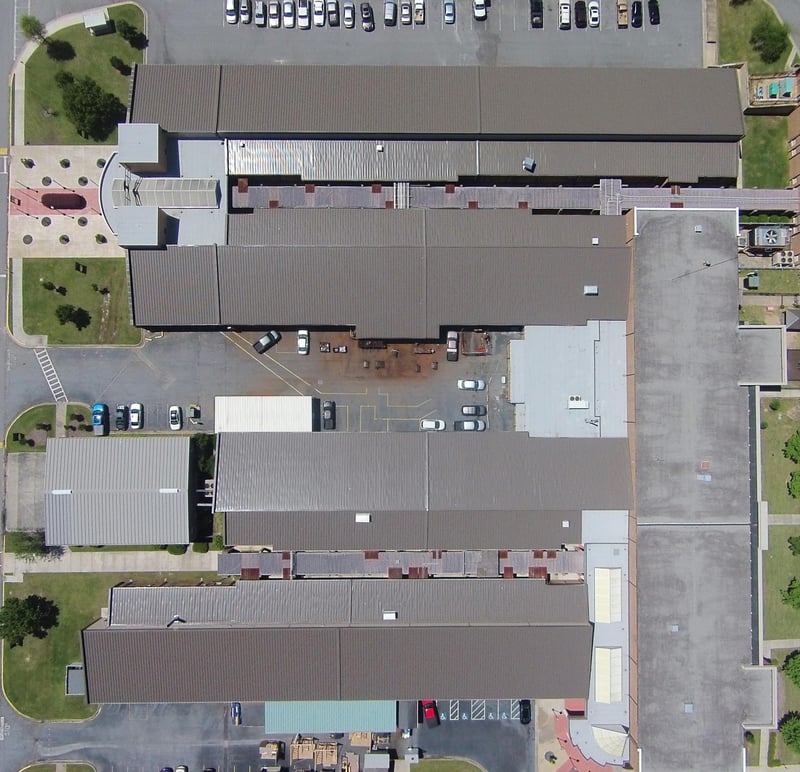
Four buildings on the Central Georgia Technical College campus in Warner Robins, Georgia, had been patched for roughly a decade before the school stopped buying time and committed to a permanent fix.
The path forward was a metal recover: McElroy Metal's 238T symmetrical standing seam panels installed over Roof Hugger sub-purlins and attached directly to the steel framing below.
By keeping the existing roof in place, the project reduced tear-off cost, limited disruption on an active campus, and delivered a metal roofing system designed for long-term serviceability.
Project Snapshot
Why did Central Georgia Technical College choose a metal recover?
After years of patching aging modified bitumen and isolated metal roof sections, Central Georgia Technical College needed a more permanent solution that worked within a limited budget.
A metal recover allowed the existing roof to remain in place while the new standing seam system was anchored directly to the building's steel framing. That approach helped reduce tear-off costs, shorten the construction schedule, and lower the risk associated with exposing occupied buildings during roof replacement.
The existing roof included modified bitumen with aluminum coating and some older metal sections. The building's shape and roof slope made long, continuous standing seam panels a practical choice.
"This facility could have been successfully reroofed with any of several low-slope options, including single plies and modified bitumen," says Jody Usry of Edifice Consulting Inc. of Byron, Ga. "The system chosen was in our client's best interest in this particular application because the shape and slope of the building made continuous-run panels practical and cost-effective. It could also be installed over existing sections covered with modified bitumen and sections already covered with metal roofing."
For building owners facing a similar decision, this project shows why recover is often evaluated on more than material cost. Existing roof condition, slope geometry, construction access, building use, and long-term maintenance needs all matter.
What roofing and wall system was installed?
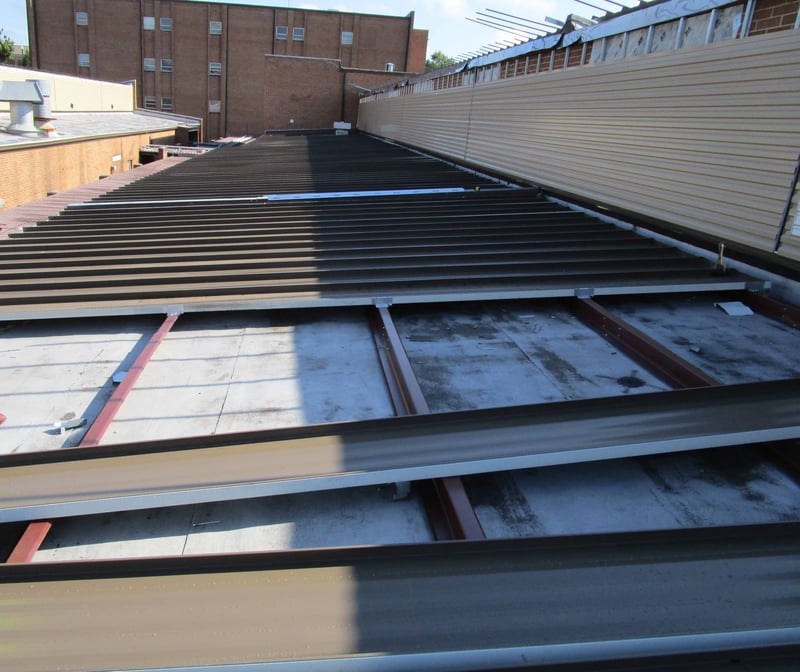
McCallum Metal Works installed 77,000 square feet of McElroy Metal's 238T symmetrical standing seam metal roofing over Roof Hugger sub-purlins. The project also included 7,800 square feet of McElroy's Wave wall panel.
Both systems were finished in Sherwin-Williams Fluropon PVDF Medium Bronze, a fluoropolymer paint system in the same chemistry family as Kynar 500® coatings commonly used on architectural-grade metal roofing and siding.
The 238T is a symmetrical standing seam profile. That means both panel legs are the same instead of being designed as a male-female pair. A mechanically seamed cap locks the panels together.
That symmetrical design gives the roof a major long-term advantage: if one panel is damaged, the cap can be removed and a single panel replaced without disturbing the panels on either side.
Because panel lengths on this project ran over 50 feet, the 238T panels had to be roll-formed on-site rather than shipped pre-cut. That capability helped preserve the continuous-panel design intent without requiring panel splices.
How did the recover solve the under-attached deck problem?
The existing roof was substantially under-attached to its cementitious wood fiberboard decking because of age and original workmanship. Installing a new roof directly to that same deck would have carried the same weakness forward.
The Roof Hugger and 238T assembly bypassed that problem by anchoring through the existing roofing and into the steel framing below. In other words, the old roof stayed in place, but the new system did not rely on it structurally.
Usry noted that the existing system's poor attachment was the limiting factor. The metal recover option made it practical to leave the failing roof in place and attach the new system directly to the building framing, a decision that "reduced expense, construction time, and risk exposure."
That is where metal recover can become especially valuable. The existing roof may no longer be dependable, but it does not always have to be removed. With the right engineering, sub-framing, and attachment strategy, the new metal roof can perform independently of the old roof beneath it.
What installation challenges did the project team face?
The project team needed enough laydown area to form and stage panels, but they also had to keep the campus functioning. That meant careful coordination among McElroy, the contractor, and the owner.
"The biggest obstacle with this project was the coordination with McElroy and the customer in setting up a time and lay-down area to run the panels off," says Dennis McCallum, owner of McCallum Metal Works. "With the panels being over 50 feet long and the project being roughly 800 squares, the panels had to be formed on-site causing us to take up a larger footprint than normal. At the time the building was in use causing us to be in a time crunch to get the panels formed and get McElroy's equipment off of the jobsite. McElroy's guys did an excellent job of getting the panels run off while our guys set them in marked off locations."
Kevin Walsh, Principal and Project Manager at Azar + Walsh Architects of Macon, Ga., said the active-campus environment also affected daily work.
"It wasn't an easy job for anyone involved with the project. The school started with a budget of about half of what they ended up spending. Once they saw what we wanted to do, they decided to find the money and do the job right. School was in session so everyone had to work around that. All the work was done on the roof, so no one had to get into the buildings, but you still have to be aware of any noise that could possibly interrupt what's going on inside the buildings."
For owners of occupied buildings, that detail matters. Roof replacement is not only about the finished assembly. It is also about how the work affects students, employees, tenants, customers, or visitors during construction.
How did the recover improve the campus appearance?
The 238T roofing and Wave wall panels created a more cohesive exterior, especially where roof planes, wall surfaces, windows, and ventilation areas met. Using roof and wall panels from a single manufacturer also helped simplify the design language across the building envelope.
"The slope of the roof made it visible from grade, and the metal roof improved the aesthetics of the campus, giving a fresher and more modern look to an otherwise rather dated complex," Usry says. "The high amount of wall surface integrated into the overall facility made an all-inclusive system of roof and wall panels from a single source practical and attractive. The system chosen facilitated the detailing of the deteriorated masonry parapet walls between the sections. The symmetrical panels allow for the practical modification of the roof planes for changes in projections in the future and isolated repairs in the event of damage."
McCallum said the project finished smoothly and credited the recover approach with helping the school meet both performance and budget goals.
"For the budget to work, the school kept the old roof on and we retrofitted a new one on top," McCallum says. "This gave them the desired building appeal while also fitting within the budget constraints."
The Central Georgia Technical College project is a useful example for owners evaluating an aging modified bitumen, built-up, or older metal roof. Tear-off is not always the only path forward.
When the existing roof geometry, building structure, and project conditions are right, a metal recover can reduce disruption, control construction risk, improve appearance, and create a roof system that is easier to service in the future.
The most important step is determining whether the existing building is a good candidate. That includes reviewing the current roof condition, structural framing, attachment options, drainage, slope, code requirements, and long-term performance goals.
Considering a metal recover for an aging low-slope building?
If you're evaluating tear-off versus recover on a commercial building with aging modified bitumen, built-up roofing, or exposed-fastener metal, McElroy Metal can help you think through panel selection, sub-purlin configuration, and structural attachment options.


.jpg?width=767&name=Can%20You%20Paint%20a%20Metal%20Roof_%20(4).jpg)

.png?width=440&height=293&name=R%20Panel%20vs%20Ag%20Panel%20(1).png)
Comments on this article:
Scroll down to the bottom to submit a comment and join the conversation. Need help or have a question? Please contact us. Looking for a distributor or contractor? Please click here to get started.