
If you are planning a high-efficiency home and you want solar on the roof, the roofing material you pick quietly decides two things: how the panels attach and how long they stay up there before the roof underneath needs work. The short answer is yes: you can put solar panels on a standing seam metal roof, and it happens to be one of the better surfaces for the job. Thin-film laminate panels bond directly to the flat of the panel, and rack systems clamp onto the raised seams without a single hole drilled through the roofing. The roof also outlasts the array, so you are not pulling solar off a few years in to replace worn shingles.
Corbin Borkholder built his own Net Zero post-frame home around exactly that logic, choosing a specific McElroy Metal roofing profile to host the solar laminate panels. Here is how the roof, the slope, and the solar came together, and what it tells you about specifying a solar-ready metal roof.
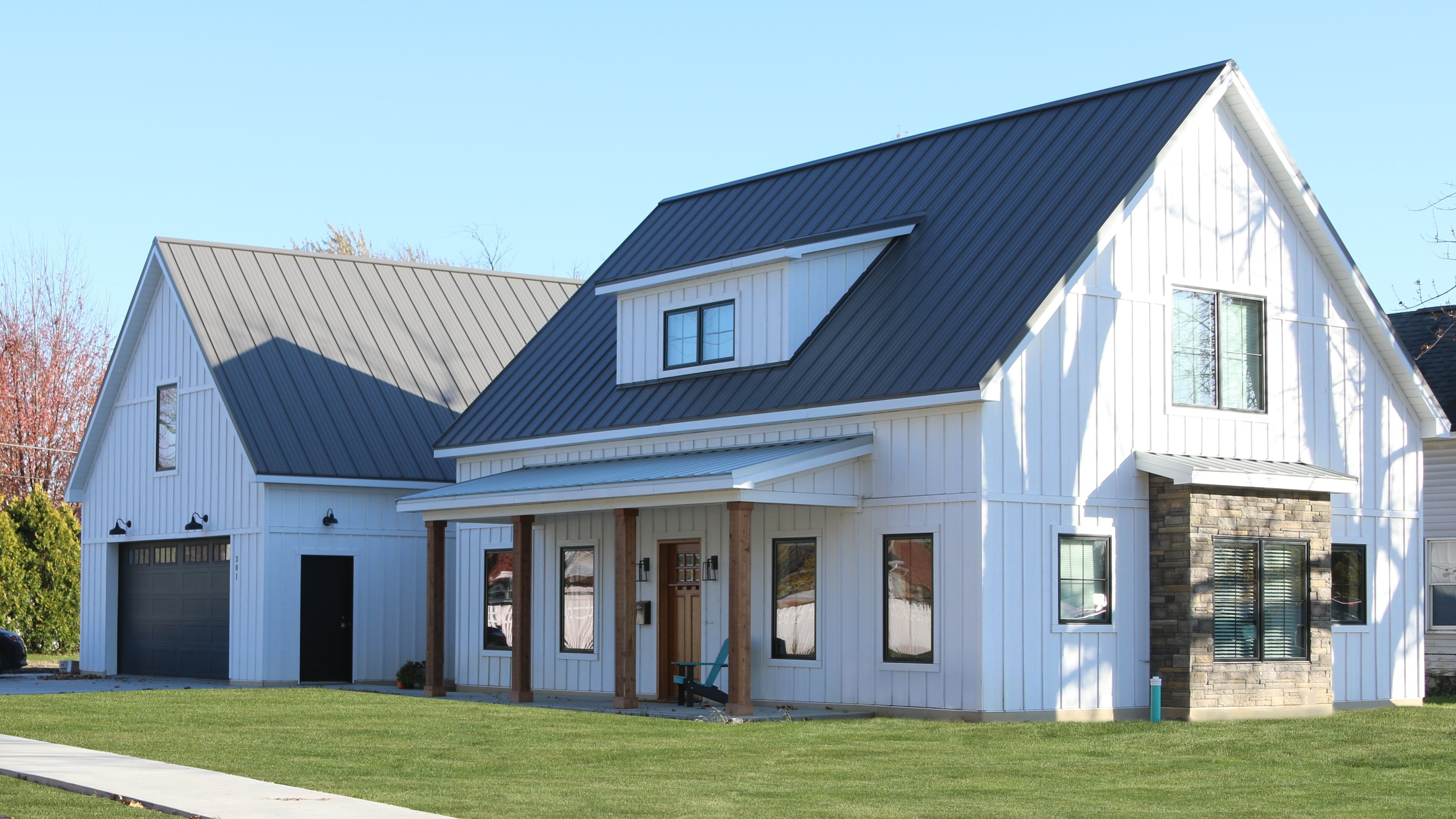
Borkholder is a sales representative for Borkholder Buildings, a custom builder based in Nappanee, Ind., where the company's corporate offices, engineering center, lumberyard, and truss manufacturing plant are located. This is Borkholder's home, completed in September 2019. It was the Residential winner of the 2019 National Frame Building Association's annual Building of the Year awards.
"I wanted an energy efficient home with minimal maintenance," Borkholder says. "It's a post-frame home on a slab. I was the general contractor with multiple subs. This was a great way for me to learn more about the low-energy homes we offer. It's a product I now live in and I believe in and it's helped me with my presentation to customers."
Can You Put Solar Panels on a Standing Seam Metal Roof?
Yes. A standing seam metal roof is one of the most solar-friendly surfaces a homeowner can choose because the panels attach without penetrating the roofing. Thin-film solar laminates adhere to the flat pan between the seams, and rigid solar modules mount on clamps that grip the raised seams. Neither method drills a hole, so the watertight surface stays intact.
That non-penetrating attachment is the practical difference between solar on metal and solar on most other roofs. With asphalt shingles, mounting hardware is bolted through the roof and sealed, and every penetration is a future leak risk that depends on the sealant holding up. On standing seam, the seam itself is the anchor point. Roofing experts cited by Bob Vila make the same observation, noting that on standing seam systems, the panels can usually be attached without drilling into the roof, which lowers the risk of leaks and simplifies installation.
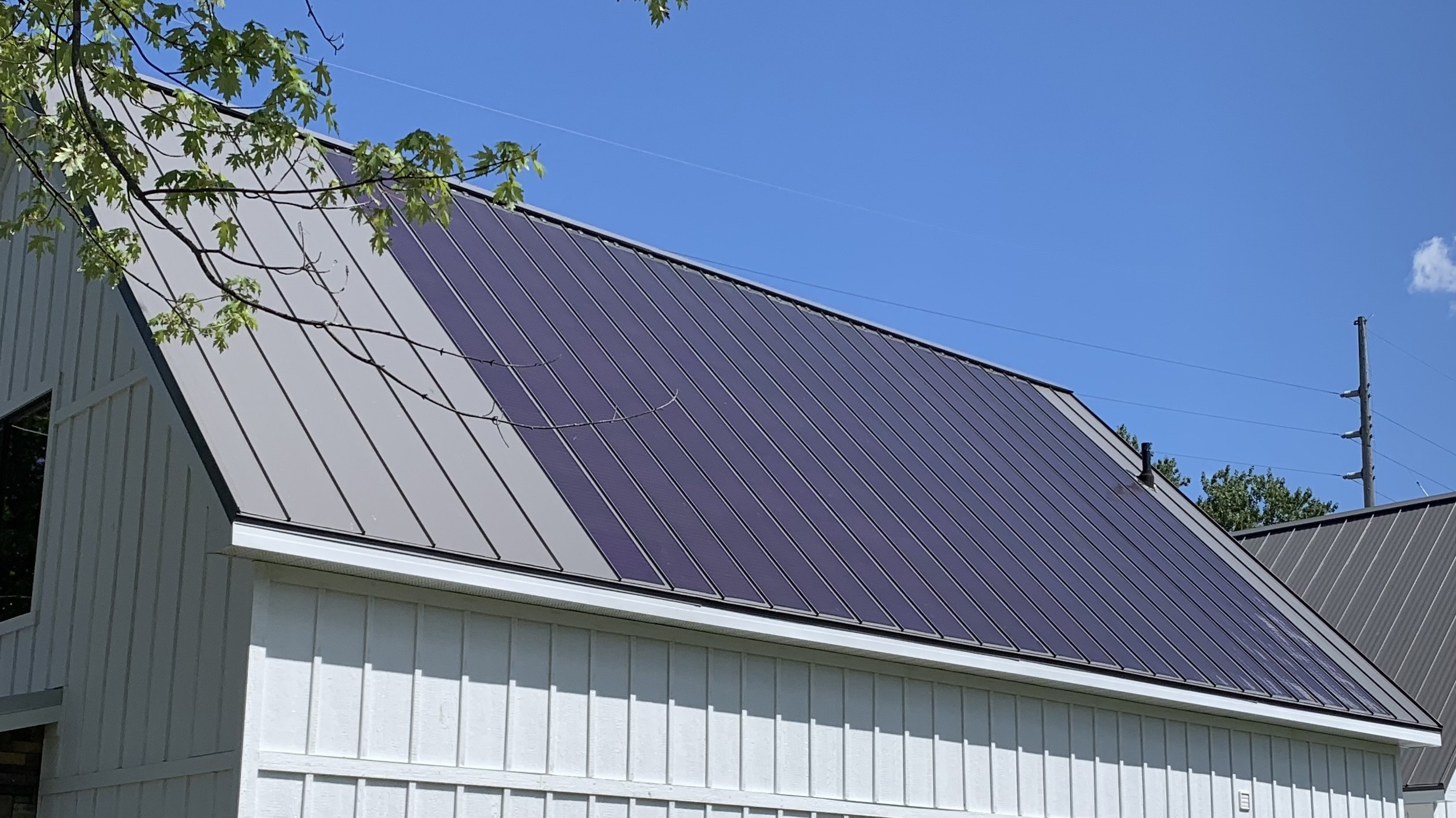
Borkholder went with the laminate route. He chose McElroy Metal coil to produce 1-3/4-inch snap-lock standing seam roofing panels, which are recognized as ideal laminate panel hosts by MiaSole of Santa Clara, Calif. The roofing panels were formed onsite by Premier Roofing and Construction of Nappanee. The striated 16-inch-wide panels that cover the majority of the home are coated with Sherwin-Williams Fluropon PVDF in charcoal. The panels on the porch are Fluropon PVDF in Silver Metallic.
Why Is Metal a Better Roof Than Shingles for Solar?
Because a metal roof outlasts the solar array, you never have to remove the panels to replace the roof beneath them. Solar modules typically run 25 to 30 years of useful life. A standing seam metal roof can last well past that, which means the surface holding your panels is good for the entire life of the system and beyond.
 A Metal Construction Association study of 14 standing seam roofs in service across the country, some already past 35 years of exposure, projected service lives in excess of 60 years. Asphalt shingles, by comparison, generally need to be replaced every 15 to 30 years, according to the Metal Roofing Alliance. Put those numbers next to a solar array, and the mismatch is obvious: a shingle roof would likely need a full tear-off once, maybe twice, during the panels' working life, and each replacement means detaching and reinstalling the entire array on top of the roofing cost.
Match a 60-year roof to a 25-year array, and that conflict disappears. The panels go up once. The roof carries them through their whole life and is still protecting the house long after they are retired. For a homeowner trying to pencil out a Net Zero build, removing the roof-replacement penalty is a real part of why solar on metal works.
McElroy Metal standing seam systems are built for that kind of service life, with concealed-clip attachment and PVDF finishes engineered to hold color and resist weathering for decades. That durability is what allows a solar array to treat the roof as a permanent platform rather than as a part it will eventually outlive.
What Roof Slope and Size Did the Net Zero Home Need?
For Borkholder's home, reaching a 6 kW system sized for a Net Zero rating meant running 19-foot MiaSole laminate panels on the south-facing slope, which in turn required a 12:12 roof pitch and 3,130 square feet of roofing. The solar target drove the roof geometry, not the other way around.
A Net Zero home produces about as much energy as it uses over a year, so the array has to be sized against the home's full demand. MiaSole offers its laminates in different lengths, and to land the output this home needed, Borkholder had to use the 19-foot panels on the south side. To install laminate panels that long, the roof had to be framed to a steep 12:12 slope. Borkholder Buildings manufactured the custom trusses for the home to carry that pitch and span.
This is the part homeowners tend to skip past. Panel length, system size, roof orientation, and slope are all one decision, made early, at the framing stage. Getting the roof right for solar is a design choice that has to happen before anyone forms a panel, which is why the roofing manufacturer and the builder need to be talking from the start.
How Are Solar Laminate Panels Attached to a Metal Roof?
Thin-film solar laminates are bonded with adhesive to the flat pan of the standing seam panel, and on this project, that was done on the ground before the roofing went up. Borkholder's crew adhered the MiaSole laminates to the McElroy Metal panels at ground level, then rolled the finished sections up onto the roof.
There is a good reason to do it that way rather than on the roof. Working flat on the ground, an installer can lay the laminates straighter and check adhesion in a controlled spot, rather than fighting gravity and footing at a 12:12 pitch. The panels are also cleaner before they go up, so the solar laminates bond better than they would to a dust-covered roof in the field. Safer, straighter, cleaner adhesion: the ground-up method earns all three.
The same logic explains why panel choice matters so much for laminate solar. The laminate needs a wide, flat, uninterrupted pan to sit on, which is exactly what McElroy's striated 16-inch snap-lock profile provides, and why MiaSole recognizes it as a suitable host.
What Does It Take to Build a Net Zero Post-Frame Home?
A Net Zero home generates as much energy as it consumes over the year, which requires a tight, well-insulated envelope working alongside on-site solar. Borkholder reached Net Zero by pairing a reflective PVDF-coated standing seam roof and the 6 kW solar array with LP Smart Siding, layered insulation, and in-floor electric heating from Danfoss Power Solutions.
The structure underneath it all is post-frame construction. According to the NFBA, post-frame is an "engineered wood-frame building system that meets UBC and IBC standards. Post-frame buildings feature large solid-sawn posts or laminated columns instead of wood studs, steel framing, or concrete masonry. These posts or columns transfer loads to the ground or are surface-mounted to a concrete pier or masonry foundation, and may use plastic barrier systems for enhanced protection of wood and concrete posts or piers." That column-based framing creates deep wall cavities and open bays, which makes it straightforward to pack in the insulation a Net Zero envelope demands.
No single product makes a home Net Zero. The reflective roof coating cuts cooling load, the solar covers generation, the insulation and tight envelope cut demand, and the heating system runs efficiently on the electricity the roof helps produce. The roof is doing two jobs at once here: hosting the array and reflecting heat that the home would otherwise have to cool away.
Is Solar on a Metal Roof Worth the Cost?
It depends on incentives and how long you keep the home, but pairing solar with a long-life metal roof improves the return for one reason that does not change: the roof never has to come off during the array's working life. On Borkholder's 2019 project, with the 30 percent federal tax credit available at that time, his expected payback on the solar investment was 8 to 10 years.
That credit no longer applies to new homeowner-owned systems. The residential Clean Energy Credit under IRC Section 25D expired on December 31, 2025, as part of the One Big Beautiful Bill Act, signed in July 2025, so a homeowner who buys solar with cash or a loan in 2026 receives no federal residential credit. Third-party arrangements such as leases and PPAs, along with state and utility programs, remain the main paths to incentives, and they vary widely by location. Anyone running payback math today should price the system against current incentives rather than the 2019 figures.
What carries over from Borkholder's project is the structural economics. A standing seam roof that lasts past 60 years means you are not budgeting for a tear-off and a solar remove-and-reinstall partway through the array's life. That avoided cost is the part of the equation a homeowner can control, and it is why a durable roof and a solar array belong together.
Borkholder keeps his home as clean as he can because he has shown it to dozens of customers in the months since it was finished. "I want them to see what we can do," he says. A roof built to host solar without penetrations, framed for the panels from day one, and engineered to outlast the array is a large part of what they are looking at.
If you are planning a solar-ready roof, compare McElroy Metal standing seam systems or talk with a McElroy Metal representative to determine which panel profiles suit solar laminates and rack-mounted arrays. Getting the roof and the solar plan aligned early is the difference between a system that works for decades and one that fights the roof underneath it.

.jpg?width=767&name=Can%20You%20Paint%20a%20Metal%20Roof_%20(4).jpg)
.png?width=440&height=293&name=R%20Panel%20vs%20Ag%20Panel%20(1).png)
Comments on this article:
Scroll down to the bottom to submit a comment and join the conversation. Need help or have a question? Please contact us. Looking for a distributor or contractor? Please click here to get started.